A dental emergency stops more than just your day. It makes it hard to talk, eat, focus, and sleep. Pain makes you pay attention. Trauma makes things unclear. Swelling makes people worry about getting an infection.
The way you react in these situations determines the outcome. Taking quick, well-informed action can protect the structure of your teeth, stop pulpal contamination, and slow the spread of bacteria. If you wait too long to get care, your fractures may get worse, you may get an abscess, or you may lose a tooth.
Before you get to an emergency dentist, this guide tells you what to do in the most common dental emergencies. It explains what to do, what not to do, and why each step is important from a clinical point of view.
When you need to see an emergency dentist right away
Some dental issues are more flexible than others. Some need help right away. Recognizing symptoms that put you at high risk protects both your oral and overall health.
If you have any of the following, you should call an emergency dentist:
- Severe, long-lasting tooth pain: Constant throbbing is a sign of irreversible pulpitis or necrosis. Inflammation in the pulp chamber raises the pressure inside and activates nerve fibers.
- A permanent tooth that has been knocked out: The periodontal ligament starts to break down as soon as it comes into contact with air.
- Swelling of the face: Swelling is a common sign that an abscess is forming. Infection can spread to nearby fascial spaces.
- Bleeding that can’t be stopped: If bleeding continues after an injury, it could mean that the soft tissue has been cut or the alveolar bone has broken.
- A broken tooth with dentin or pulp that can be seen: Exposed inner layers let bacteria in and cause infections quickly.
Minor sensitivity, a small chip that doesn’t hurt, or mild gum irritation are all less urgent problems. If you’re not sure what’s wrong, tell the dental team exactly what your symptoms are. Triage correctly keeps problems from happening.
How to Deal with Bad Tooth Pain Before Your Visit
Severe tooth pain is often caused by pulpal inflammation, deep decay, trauma to the tooth’s surface, or a cracked tooth. Only definitive treatment can get rid of the source, but controlling your symptoms before your appointment will make you more comfortable and less stressed.
The inflamed pulp tissue gets bigger inside a small space. More pressure makes blood vessels smaller and activates nociceptive fibers. This process causes sharp, throbbing pain that usually gets worse at night.
Things you can do right away to feel better:
- Wash with warm salt water: A saline rinse gets rid of bacteria on the surface and cleans up debris around the gums.
- Carefully floss around the tooth that hurts: Food impaction can put pressure on the periodontal ligament in one area.
- Put a cold compress on the outside of your cheek: Cold slows down blood flow and limits the body’s response to inflammation. Use breaks of ten to fifteen minutes.
- Follow the directions on the label when taking anti-inflammatory drugs: Nonsteroidal anti-inflammatory drugs help keep inflammation in the tissues around the teeth under control.
Things to Do to Stay Safe Until You Get to the Clinic
- Don’t chew on the side that hurts.
- Stay away from foods that are very hot or very cold.
- Keep your mouth clean in a gentle way.
Don’t put aspirin on your gums. Direct contact can hurt the mucosa. Don’t put heat on swollen areas because it could make the inflammation worse by increasing blood flow.
These steps help for a short time. Pain that doesn’t go away or gets worse is a sign of a problem in the pulp or periapical area.
What to Do If a Tooth Gets Knocked Out
If you knock out a permanent tooth, you need to act quickly and correctly. How well you protect the root surface before you get to the emergency dentist will determine the outcome. The periodontal ligament fibers that connect to the root let the tooth reattach to the bone. Long-term stability goes down when these cells dry out.
- Hold the Tooth by the Crown: Only touch the tooth where you can see the chewing surface. Don’t touch the root. To successfully reimplant the root, the delicate ligament fibers on its surface must stay intact.
- Rinse Without Scrubbing: If the tooth is dirty, rinse it under clean running water for a few seconds. Don’t scrub. Don’t scrape. Mechanical friction hurts cells that can live.
- If you can, put it back in: If the patient is still awake and willing, carefully put the tooth back in its socket. Put some light pressure on the gauze and bite down on it to keep it in place. Reinserting right away keeps the body hydrated and makes the prognosis better.
- Store It Right If You Can’t Put It Back In: If you can’t put the tooth back in the socket, put it in cold milk. Milk is a good place for cells to live. If you don’t have milk, you can use a tooth preservation kit or saliva from inside your cheek. Don’t wrap the tooth in tissue or leave it out to dry.
- Get to an emergency dentist in less than an hour: Time has a direct impact on success. The first hour is when the chances of functional reattachment are highest. Not getting care right away raises the risk of root resorption and long-term instability.
Do not try to put primary teeth back in. Call the dental office for help with kids.
What to Do If You Have a Broken or Cracked Tooth
A broken tooth can be as small as a chip in the enamel or as big as a deep structural problem that affects the dentin or pulp. Even tiny cracks can get bigger when you chew. Early protection stops more damage from happening.
- Find out how deep the fracture is: Fractures in the surface enamel may not hurt too much. Patients frequently experience heightened sensitivity to temperature when dentin is exposed. Bleeding and severe pain may happen if the pulp gets involved.
The depth of the problem affects how urgent it is and how complicated the treatment is.
- Keep the rest of the tooth structure safe: To get rid of debris, rinse your mouth with warm water. Put any broken pieces you find in a clean container. Your dentist may look at them to see if they can be fixed.
- Don’t chew on the side that hurts: Too much occlusal force can make the fracture line go toward the root.
- Protect Sharp Edges: If sharp enamel hurts your tongue or cheek, put dental wax over the area. This lessens damage to soft tissue before your appointment.
- Use cold to reduce swelling: If the fracture was caused by trauma, put a cold compress on the outside of the cheek. Cold slows down the body’s inflammatory response and makes you feel better.
Cracks that go straight down into dentin make it more likely for the pulp to become infected. Quick assessments allow for stabilization through bonding, onlays, or crowns, potentially preventing more complex issues down the line.
When is Urgent Dental Care Needed for Swelling, Infection, or Abscess?
Swelling often indicates that an infection has moved beyond the tooth itself. Bacteria can infiltrate surrounding bone and soft tissue once they escape the root canal. The longer you wait, the greater the risk of escalation.
Where the Infection Starts
Most abscesses start with a cracked tooth, untreated decay, or a restoration that didn’t work. Bacteria get into the pulp, build up pressure inside the canal, and then move through the root tip into the bone. At this point, the source inside the tooth needs to be taken out. Antibiotics alone won’t fix it.
Signs That Need Immediate Attention
Localized swelling near one tooth, pain when biting, a bad taste, or sore gums are all signs of an infection. A fever, an uneven face, or a limited range of motion in the jaw could mean that the infection has spread.
Less pain doesn’t mean the infection is gone. Necrotic pulp can hide how bad it is.
What to Do Before Going to the Dentist
Use warm salt water to rinse. Put a cold pack on your cheek. Raise your head.
Don’t use heat. Don’t try to drain.
If you have trouble breathing or swallowing, get medical help right away.
What to Do If Your Crown or Filling Falls Out
A crown or filling strengthens and seals a tooth that has become weak. When it comes loose, dentin is exposed and can be broken or infected by bacteria.
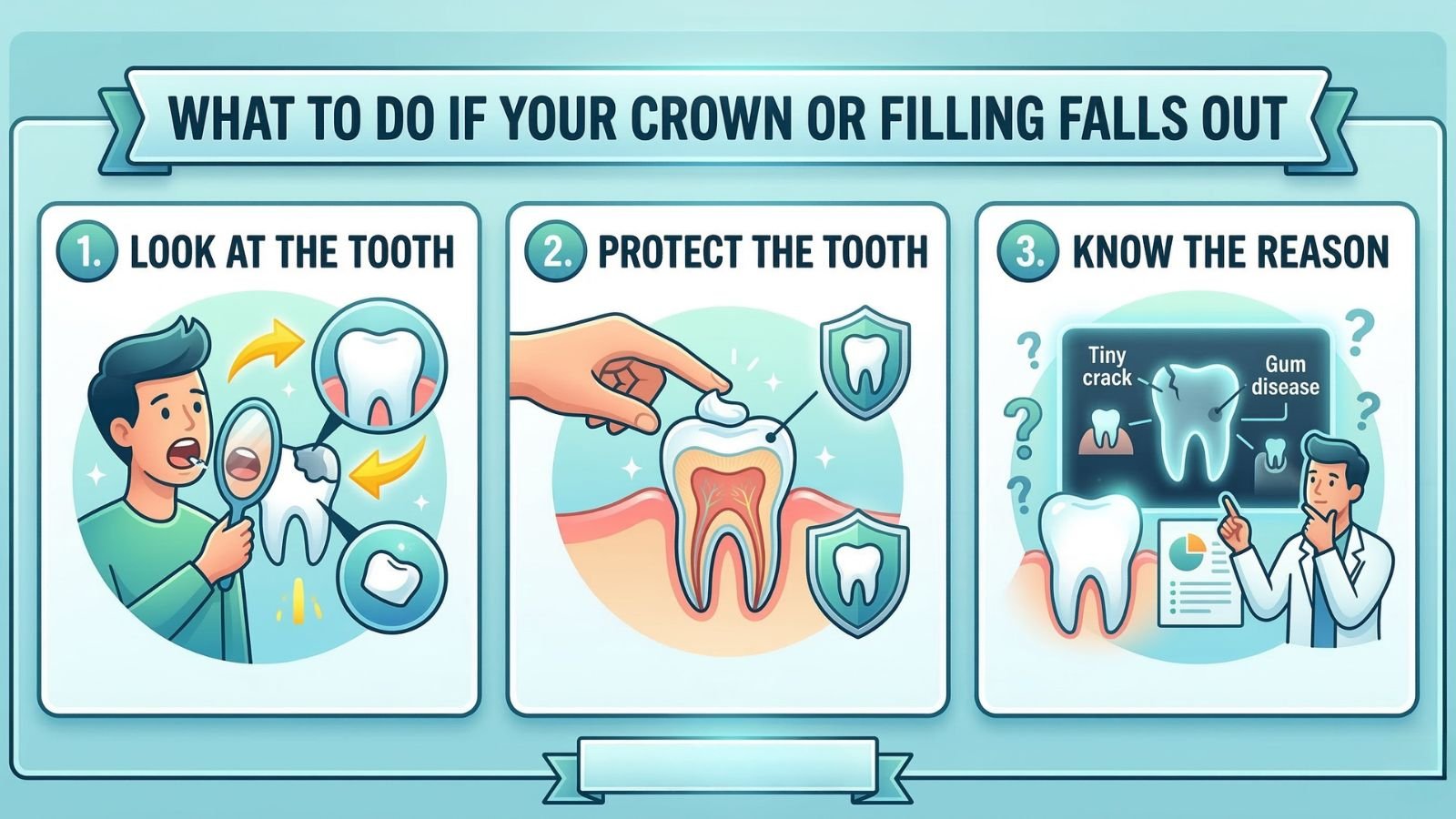
- Look at the tooth: Look for visible signs of decay, cracks, or movement. When your teeth are sensitive to air, it usually means that the dentin is exposed. If the rest of the structure is in good shape, simple reconstruction will work.
- Protect the Tooth: Rinse and store the restoration. Gently clean the tooth. Don’t chew on that side. Temporary dental cement can protect your teeth until your appointment.
- Know the Reason: Restorations can come loose because of repeated decay, broken cement, or too much pressure on the teeth. Before replacing or rebuilding the tooth, your dentist will check to see if it is still strong.
If you wait too long, you are more likely to get sick and break something. Quick evaluation helps keep long-term function.
Where should you go: the emergency room or the emergency dentist?
Picking the right place keeps things moving and makes sure you get the right care. Not all dental emergencies need to be treated in a hospital, but some injuries are too serious for a dental office.
- Go to the ER If: You have a head injury, lose consciousness, think you might have a broken jaw, or have a serious facial injury. If you have trouble breathing or swallowing, you should also go to the hospital right away. These conditions mean that the airway or structure is not working properly.
- Call an emergency dentist if: You have a dental abscess, a broken crown, severe tooth pain, or swelling in one area. Dentists give the best care for infections, broken bones, and failed restorations.
Hospitals help people with life-threatening conditions get better. Emergency dentists fix the problems that cause tooth problems.
What to Anticipate at an Emergency Dental Appointment
It’s completely normal to feel a bit on edge when you’re not sure what’s coming. Knowing what to expect can often ease that anxiety.
Focused Examination
The dentist meticulously evaluates tooth mobility, the tooth’s reaction to percussion, the condition of the adjacent tissues, and the overall alignment of the bite.
This examination helps pinpoint any structural problems or issues with the tooth’s nerve.
Diagnostic Imaging
Digital radiographs can show root fractures, periapical lesions, bone loss, or leftover fragments. Imaging helps confirm the cause of pain or swelling.
Immediate stabilization is essential.
Treatment options might include pulp therapy, incision and drainage, splint placement, temporary restoration, or recementation. The main goals are to manage pain and control infection.
Next Steps
After the immediate problem is addressed, the dentist will suggest a long-term fix. This might mean a root canal, a crown, or possibly something more involved like surgery. A carefully considered plan is essential for achieving the best results in the long run.
Emergency care prioritizes immediate relief and safeguarding, followed by the eventual goal of complete recovery.
How Paragon Dental Solutions Gives Emergency Care Right Away
Dental emergencies need quickness, accuracy, and clinical judgment. Paragon Dental Solutions offers focused urgent care that aims to ease pain, stop infections, and keep the natural structure of teeth intact.
- Same-Day Emergency Appointments: The team puts urgent cases first and makes room for patients who need to be seen right away. Quick access lowers the chances of infection spreading or fractures getting worse.
- Immediate Pain Control: Doctors deal with pain at the start of the visit. Local anesthesia and targeted treatment lower the pressure in the pulp and stabilize tissue that is inflamed.
- Advanced Diagnostic Imaging: Digital radiography helps to accurately find root fractures, periapical pathology, and structural damage. Clear images help doctors make the right treatment choices.
- Conservative, Evidence-Based Treatment: The goal is always to keep natural teeth whenever possible. Each suggestion takes into account the structural integrity, pulpal status, and long-term outlook.
- Open planning and clear communication: Patients get a direct explanation of their diagnosis, the treatment options available to them, and what they can expect to happen. Decisions that are based on facts lead to predictable results.
- Organized Follow-Up Care: The first step is emergency stabilization. The team makes a final treatment plan to get back strength, function, and durability.
If you have severe tooth pain, swelling, trauma, or a sudden failure of your restoration, contact Paragon Dental Solutions right away. Taking care of your teeth right away keeps them healthy and stops problems that could have been avoided.
FAQs
- How can I tell if my tooth pain isa real dental emergency?
Ans. When tooth pain keeps you from sleeping, spreads to your jaw or ear, or comes with swelling, fever, or trouble chewing, it becomes an emergency. If you have sharp pain from an injury or sudden pressure, you should also get checked out right away. Pain that doesn’t go away is often a sign of a pulpal infection or a broken structure.
- Is it possible for an emergency dentist to treat an abscess on the same day?
Ans. Yes. An emergency dentist can figure out what’s wrong with the infection, relieve pressure, and start the right treatment. Depending on how well the structure holds up, this could mean drainage, root canal therapy, or extraction. Early intervention stops the spread to nearby bone or soft tissue.
- What should I do if I break atoothbut it doesn’t hurt?
Ans. A crack can go all the way through the dentin or even the pulp without hurting. Don’t chew on that side and make an appointment for an evaluation as soon as you can. Getting treatment early lowers the risk of infection and damage to the structure.
- Do emergency dental visits cost more than regular ones?
Ans. The cost depends on what needs to be done. An exam and radiographs are still set up the same way as regular visits. The final cost depends on how complicated the treatment is. Quick care often stops more extensive and expensive reconstruction from happening later.

As the leading cosmetic dentist in Modesto, CA, and founder of Paragon Dental, I’m proud to serve our community with state-of-the-art care. A Fellow of the International Congress of Implantology (ICOI) and Associate Fellow of the American Academy of Implant Dentistry (AAID), I focus on advanced, evidence-based care. Through continuous learning and modern technology, my team and I are committed to delivering comfortable, personalized treatment for healthy and lasting smiles