
People don’t think much about a missing tooth at first. But after a while, the small things start to feel strange. Some foods become harder to eat, speech may not be as clear, and the empty space can slowly affect the surrounding teeth.
Many patients turn to dental implants instead of temporary fixes for this reason. Implants are not solely for aesthetic purposes. They bring back the comfort, the support and the feeling of a natural tooth once again.
It’s natural to wonder what the treatment process really involves if you’re considering it. This guide walks you through the dental implant procedure in Modesto, step by step, so you know what to expect before treatment begins.
What Are Dental Implants and Who Needs Them?
Dental implant replaces a missing tooth from the root itself. Your dentist implants a small titanium post into the jawbone, and after it heals, a custom-made crown is attached on top. When all is said and done, it feels a lot more like a real tooth than a removable option like dentures.
- What is replaced by a dental implant?
It replaces the whole tooth, not just the part you see above the gums. The implant root is placed inside the jawbone and helps support the area after tooth loss.
- Who is a candidate for dental implants?
Most adults with healthy gums and missing teeth may be candidates for implants. Even if there is some bone loss, your dentist may still suggest treatments such as bone grafting to ready the area.
- Why do so many people want implants?
Many patients just want something that feels steady. Dentures can move when you eat or talk and this can be uncomfortable or embarrassing. Implants stay in place and function more like natural teeth.
- What is the difference between implants and bridges or dentures?
Bridges are supported by the teeth on either side of the gap while dentures sit on top of the gums. Implants work differently because they “fuse” with the jawbone. This support tends to give them a greater sense of strength and security in the long run.
Also Read: Considering Dental Implants in Modesto? Everything You Need to Know Before You Decide
Why Dental Implants Are a Preferred Solution
Dental implants aren’t just about closing the gap you can see. They actually help bring back normal function and support what’s underneath too, like the bone and overall structure of your mouth.
Here’s why a lot of patients end up choosing them:
- Stable and secure fit: The implant sits in the jawbone, so it stays in place. No slipping, no movement. You can eat and talk without worrying about it shifting like removable options sometimes do.
- Helps keep jawbone from shrinking: When a tooth is missing, the bone in that area slowly starts to reduce over time. An implant helps “activate” that area again and keeps the bone from thinning out so quickly.
- Looks and feels natural: Once the crown is placed, it generally just feels like a regular tooth. It sits in line with your other teeth and doesn’t stand out.
- Doesn’t affect nearby teeth: Unlike bridges, implants don’t need support from the teeth next to them. So those healthy teeth are left untouched.
- Lasts a long time: If you take care of it properly, an implant can last for many years. You don’t keep replacing it the way you might with some other options.
In short, implants don’t just fix the empty space. They also help protect what’s still there. That’s why they’re often preferred for missing teeth treatment in Modesto.
Step-by-Step Dental Implant Procedure
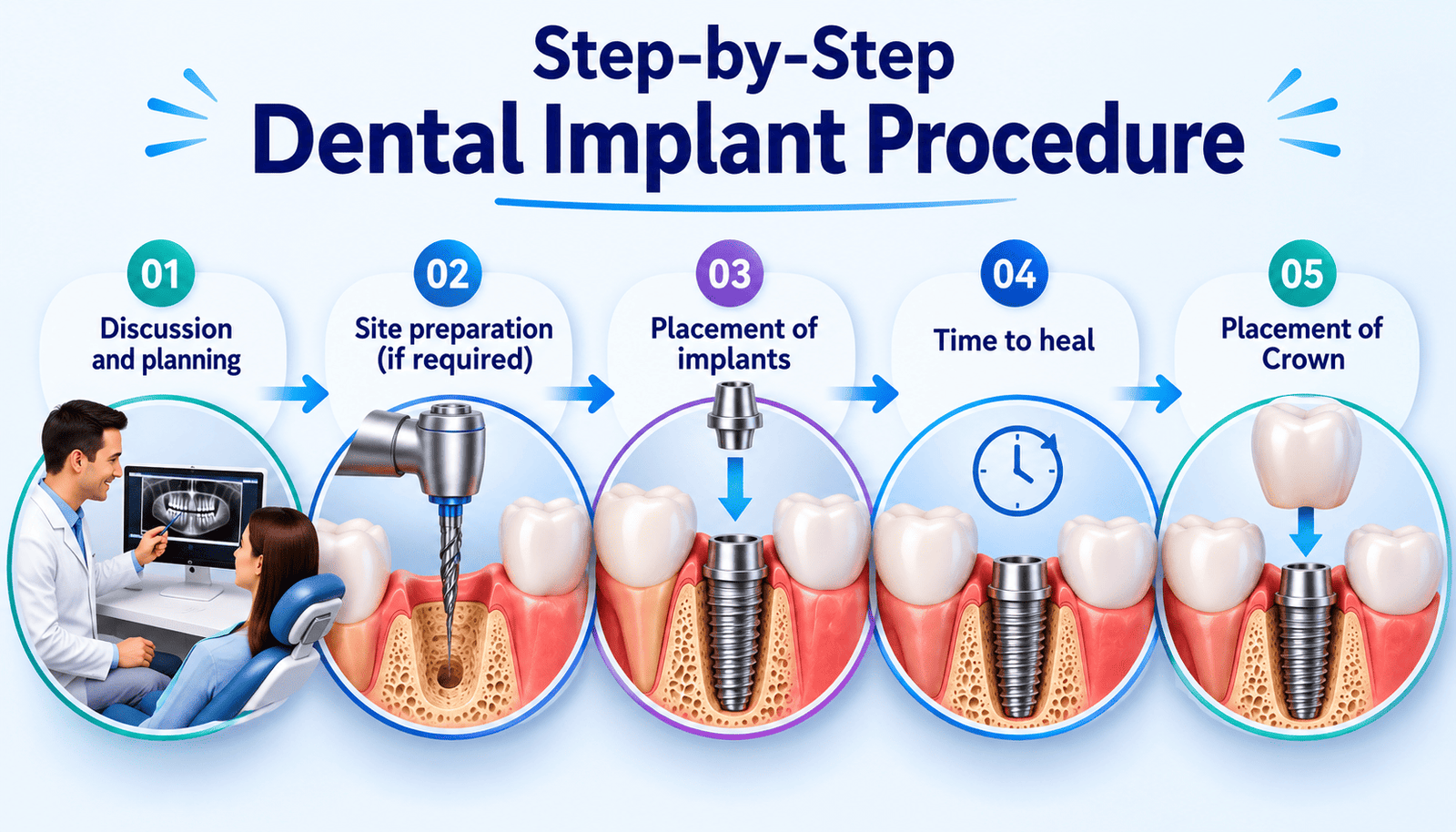
Usually the process of implant is stepwise. Nothing was rushed. Each stage just flows into the next so the end result feels natural and stable.
This is what it generally looks like:
1. Discussion and planning
Your dentist begins by looking at your teeth, gums and jaw. Scans or x-rays are taken to view what’s going on under the surface and where the implant should be placed. They also sometimes check if there’s anything else to be done before starting.
2. Site preparation (if required)
If the bone in that area is not strong or thick enough, a small bone graft may be recommended. Basically, it helps to create a solid base for the implant to hold well later on.
3. Placement of implants
A small titanium post is implanted in the jawbone. This serves as the roots of the missing tooth.
4. Time to heal
That’s the waiting period. The bone gradually grows into the implant. Nothing fancy here, but this is the step that gives the implant its long term solidity.
5. Placement of Crown
Once this has healed and the tooth has settled, a custom-fitted crown is placed on top. This is the part that you see and use, just like a natural tooth.
Each step is important by itself. But when they come together right, it often feels steady and pretty natural over time.”
You Might Also Like: Cosmetic Dentistry in Modesto: How to Improve Your Smile with the Right Treatments
Recovery and Healing
How well a dental implant lasts has a lot to do with healing. After the implant is in place, time is needed for your body to adapt and heal around it.
This is what most can expect.
- The first days: It’s normal to have some soreness, swelling and sensitivity after the procedure. It may be uncomfortable for a few days but usually improves with rest, soft foods and simple care.
- It takes time to heal: The implant takes time to fuse with the jaw bone. This doesn’t happen overnight; it takes a few months. That’s the healing process that gives the implant the strength and stability.
- Everyday care matters: It does heal, but the area has to stay clean. A little brushing and listening to your dentist can help you avoid problems down the road.
- Expect to be uncomfortable: Initially some swelling and tenderness around the implant site is common. Most people find it improves as the area heals.
- When you should call your dentist: If the pain is increasing rather than improving, or if you notice swelling, bleeding, or signs of infection, it is best to have it checked early.
It takes time for healing, but every step helps the implant settle in properly for the long term.
How to Choose the Right Dentist in Modesto
Dental implants are not just about the procedure itself. It is critical that the dentist taking the case from the start is good planning, clear directions, and correct follow-ups often make the biggest difference.
Here are a few things to look for before choosing an implant dentist:
- Experience in implant cases
Implants are precise and require a lot of planning. Usually a dentist who regularly works with implant cases is better equipped to handle issues such as bone loss, missing multiple teeth, or bite alignment problems.
- Proper pre-treatment assessment
The process should not be hurried. A good dentist will look at your teeth, gums, jawbone and scans carefully before recommending treatment. You should also know what the process will be from beginning to end.
- Straightforward, honest communication
You should not walk out of the clinic confused. The dentist should explain the timeline, healing period, costs and possible challenges in an understandable manner.
- After placement follow-up care
Implants heal properly and take time so follow up visits matter. Having a dentist who is involved after the procedure can catch small problems early and make sure healing stays on track.
- Focus on long-term results
A dental implant should not be just a filler for a space. It should be stable, comfortable and fit in with the rest of your teeth.
A good dentist can make the whole thing seem more clear and manageable.
Conclusion
Dental implants provide a structured approach to replacing missing teeth. Each step is a step toward a result that restores function and promotes longevity of the oral cavity.
It takes time, but it’s a clear process. If they are well-planned and precisely executed, implants offer a stability that other solutions cannot match.
If you are looking for dental implants in Modesto and want a clear plan that is tailored to your case, book a consultation with Paragon Dental for a detailed evaluation.

As the leading cosmetic dentist in Modesto, CA, and founder of Paragon Dental, I’m proud to serve our community with state-of-the-art care. A Fellow of the International Congress of Implantology (ICOI) and Associate Fellow of the American Academy of Implant Dentistry (AAID), I focus on advanced, evidence-based care. Through continuous learning and modern technology, my team and I are committed to delivering comfortable, personalized treatment for healthy and lasting smiles