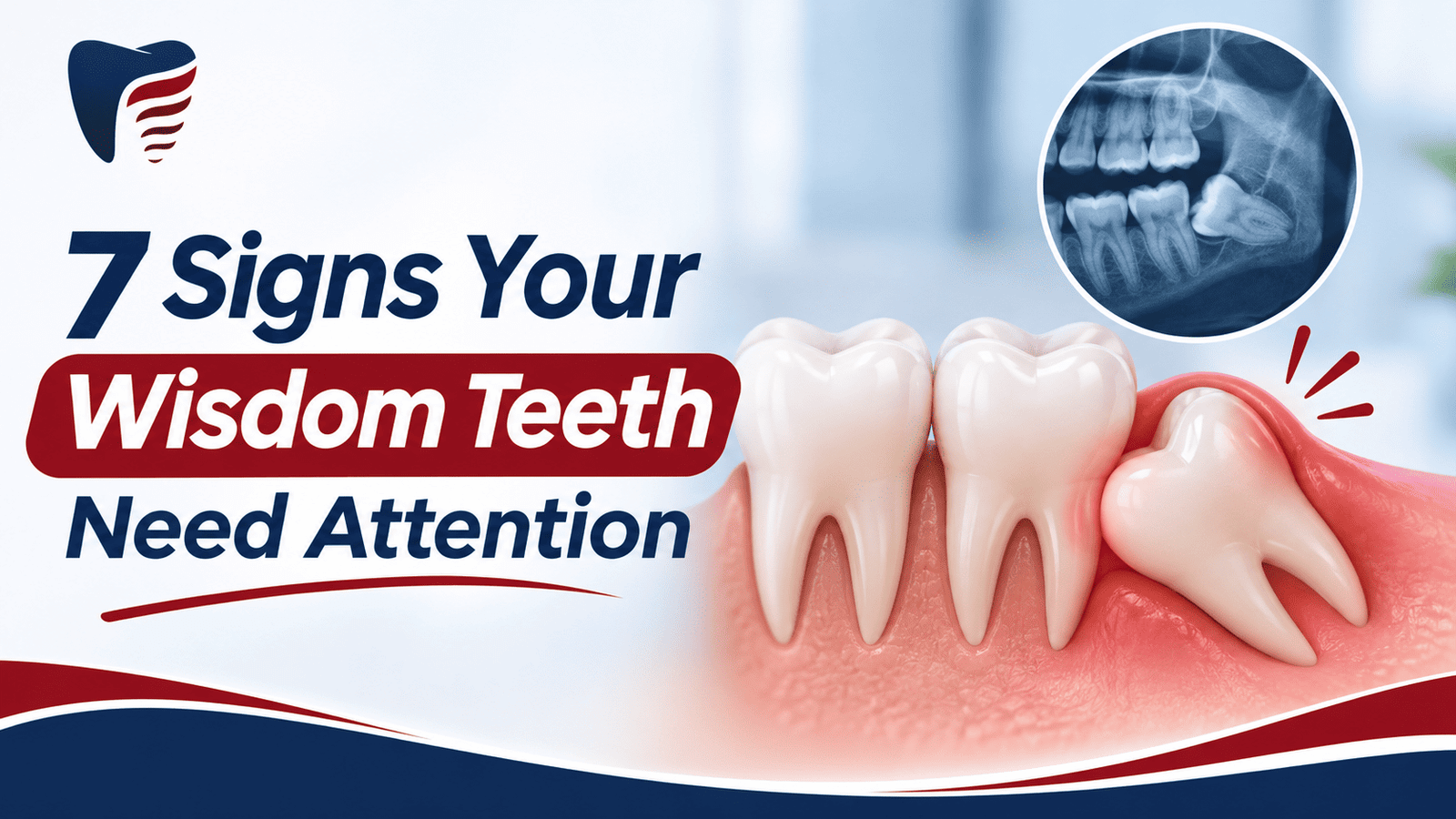
Wisdom teeth usually appear between the ages of 17 and 25. But if your jaw is not big enough to accommodate them, they can become stuck under the gums, crowd the teeth around them, or allow food to get caught around them. This can lead to pain, swelling, and inflammation of the wisdom teeth.
In this guide, we’ll explore seven indicators of wisdom tooth problems, how to detect whether a tooth is impacted, and when you might need wisdom teeth removal in Modesto.
What Causes Wisdom Teeth Pain?
The wisdom teeth come through right at the back of your mouth. There might not be room for them to come through properly. There are a couple of reasons this can hurt:
• Impaction: The tooth is stuck under the gums or jawbone, or is tilted.
• Pericoronitis: When a wisdom tooth has partially erupted, a flap of gum may cover part of the tooth. Food and bacteria can get caught underneath which can cause inflammation or illness.
• Tooth Decay: Wisdom teeth are at the back of the mouth, and difficult to keep clean. Cavities are caused by the accumulation of plaque and food particles.
• Pressure on adjacent teeth: A wisdom tooth that grows at an angle can put pressure on the adjacent tooth, which can lead to discomfort.
Your dentist can take x-rays and undertake a dental exam to help get to the root of the problem. If the discomfort continues, you should visit your dentist to check for impaction, decay, or infection. They will recommend the appropriate therapy.
7 Signs You Should Have Your Wisdom Teeth Checked
Getting wisdom teeth is usually not easy. They don’t always have enough space to develop normally. In other cases, a partially erupted tooth traps food and bacteria. Seven signs your wisdom teeth may need attention.
1. Your Mouth Hurts in the Back
If you have pain near to your last molars, your wisdom teeth may be erupting, or a tooth may be wedged behind your gums. An infection can also cause pain in this location. If the pain doesn’t go away by itself, see your dentist.
2. Gums Tender or Swollen
Look at the gums behind your last molars. If they are large or unpleasant, a partially erupted wisdom tooth may be the explanation. A flap of gum covers part of the teeth, trapping food & bacteria. This can cause pericoronitis, inflammation that causes discomfort, and swelling around the tooth.
3. Pain When Eating
Pain when biting near the back molars could be a sign of sore gums, a cavity or an impacted wisdom tooth. Don’t ignore the discomfort, especially if it gets worse when eating. Your dentist might look at the wisdom tooth to see if it is affecting the neighboring teeth.
4. Bleeding or Red Gums Around the Teeth
Do your gums bleed when you brush toward the rear of your mouth? Redness and bleeding around a wisdom tooth that is erupting may be a sign of inflammation. If they are accompanied by discomfort and swelling or continue, get them evaluated.
5. Bad Taste or Bad Breath
When wisdom teeth do not entirely erupt, food can get stuck around it. Bacteria can be hard to clear and can build up and create bad breath. You also may have a terrible taste in your mouth. If you see a pus or an unpleasant taste around the tooth, it may be because you have an infection.
6. Jaw Stiffness or Pain
An inflamed wisdom tooth may lead to a sore jaw or make it difficult to open your mouth wide. It can also make you feel uncomfortable eating. If you have stiffness or are having more difficulty opening your jaw, see a dentist.
7. Swelling of Face or Jaw
Swelling on your cheek or jaw can be a sign of infection around a wisdom tooth. If you notice swelling with or without fever or worsening of the swelling, see a dentist immediately. Get emergency medical help if you have trouble breathing or swallowing.
You can have your wisdom teeth checked before they start hurting you unbearably. If you are experiencing any of these symptoms, your dentist can check the region for infection or impaction and if any treatment or removal is necessary.
Also Read: Why Are Your Gums Bleeding? Common Causes and Treatment Options in Modesto
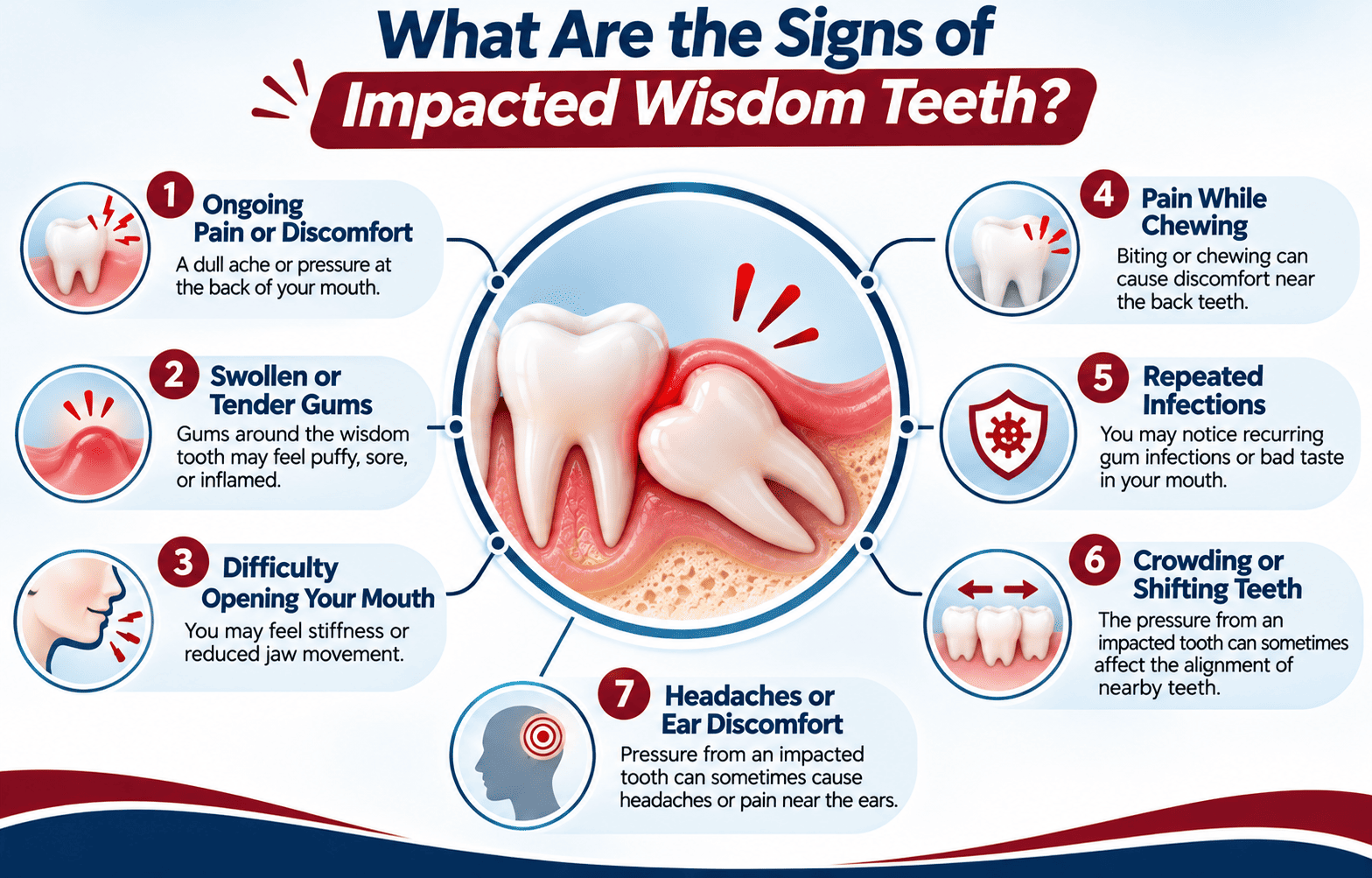
What Are the Signs of Impacted Wisdom Teeth?
Impaction of a wisdom tooth happens when the tooth doesn’t have enough room to grow or grow at an angle. It may be lodged under the gum or jawbone. Sometimes an impacted wisdom teeth creates no symptoms at all.
If the tooth begins to cause trouble you may observe:
• Occasional pain or pressure close to your back teeth.
• Red, puffy or sensitive gums that surround a tooth that has just partially erupted.
• Gum infections occur when food and germs get trapped under the gum tissue. This can cause a condition called pericoronitis.
• Difficulty opening your mouth wide due to jaw pain or tightness.
• A foul taste or breath is produced by bacteria around the infected tooth.
These symptoms can indicate an impacted wisdom tooth, but you cannot be sure of this by the symptoms alone. Your dentist will look in your mouth and may take dental x-rays to see where the tooth is, how the roots have grown, and if it is affecting the teeth next to it.
If your tooth is causing frequent infections, constant discomfort, decay, or damage to the second molar, your dentist may propose removing it. If it doesn’t create any trouble, it may not need to be removed. Your dentist can monitor it during your usual checks and provide treatment if any concerns occur.
When Should You See a Dentist for Wisdom Teeth Pain?
If your wisdom tooth has been sore for a few days or the pain comes and goes, see a dentist. Other symptoms you can notice are swollen gums, bad breath, or pain when you chew. This may happen when the tooth doesn’t have enough room to come through, develops a cavity, or produces an infection surrounding the gums.
Look for pus, fever, swelling in your face or difficulty opening your mouth. These symptoms may be signs of an infection that needs to be treated quickly. If you have difficulty breathing or swallowing, seek emergency medical help.
Your dentist will look at the tooth and may also take X-rays to evaluate how the tooth is positioned under the gums and if it’s hurting neighboring teeth. This helps them to assess what treatment you need and whether removing the wisdom tooth is the best option.
Do All Wisdom Teeth Need to Be Removed?
Your dentist may suggest removing a wisdom tooth if it continues to cause pain, becomes infected repeatedly in the gums, decays, or harms the tooth beside it. Plus, an impacted wisdom tooth is hard to clean correctly and can sometimes retain food and bacteria too.
However, not all impacted wisdom teeth require removal. If it’s not bothering you and your dentist doesn’t see any evidence of disease or damage, he or she may just have you come in for regular checks and X-rays.
Your dentist will examine the position of the tooth, the development of the roots, and the impact on the adjacent teeth or the surrounding bone. If removal is the best option, they’ll walk you through the operation and recovery, as well as the potential hazards.
If your wisdom tooth still hurts, don’t just ignore it or think that the only option is to get it taken out. Book a dentist appointment to discover the cause of the discomfort and what therapy makes the most sense for you.
Must Read: 5 Signs You Need a Dental Filling Replacement
What Happens During Wisdom Teeth Removal?
Removal of wisdom teeth is a surgery that removes one or more wisdom teeth. Where they are determining how your dentist removes them. A tooth that has erupted normally through the gum usually needs a less complicated operation than one that is trapped under the gum tissue.
Before the extraction, your dentist will inspect your mouth and take dental X-rays to determine the position and roots of the tooth. They will give you a local anesthetic to numb the region. For more complicated extractions, they may additionally consider sedative options.
If the wisdom tooth has fully emerged, your dentist will typically be able to extract it, first loosening it with dental equipment. Sometimes an impacted tooth requires a bit more work. The dentist may make a small cut in the gum and remove some bone or divide the tooth into smaller parts to safely remove it. They may also put stitches in to help them recover.
After wisdom teeth removal, some pain, swelling and jaw stiffness should be expected. Your dentist will tell you how to deal with the pain, how to keep the extraction site clean, and how to care for your mouth while it recovers.
Wisdom Teeth Removal in Modesto
If your wisdom teeth pain is a recurring problem, a dental examination you figure out what’s going on and what to do next. If you’re experiencing pain from your wisdom teeth, a dentist at Paragon Dental in Modesto may review your symptoms, check out the area, and see if wisdom teeth removal may give you some relief.
Your consultation may involve an oral exam and dental X-rays to look for impaction, infection, decay or damage to surrounding teeth. The dentist will use the results to describe your options for treatment and what to expect in terms of the procedure and recuperation.
Wisdom teeth pain? Schedule your appointment now at Paragon Dental in Modesto. Have your symptoms checked and find out what caused them and what treatment is best for you.
FAQs
What are the symptoms of impacted wisdom teeth?
Impacted wisdom teeth can cause pain in the back of your mouth, swollen gums, jaw rigidity, and difficulty chewing. You may also see recurring gum infections around the teeth. Some affected wisdom teeth do not create any symptoms. A dentist can examine and take dental X-rays to see their position.
How long does discomfort from wisdom teeth last?
Mild pain as a wisdom tooth comes through may resolve within a few days. If the pain comes back and gets worse, the tooth may be impacted, decaying, or infected. If the pain does not stop it is better to call the dentist.
Do impacted wisdom teeth cause jaw pain?
Yes. Swelling and irritation of the gums around your back molars can be caused by impacted wisdom teeth. You might have pain in your jaw, tenderness, or difficulty opening your mouth fully.
Do I need to have all the affected wisdom teeth removed?
Nah. If an impacted wisdom tooth isn’t causing any pain or damage, your dentist may just watch it at regular checkups. If the tooth results in persistent infections, decay, cysts or harm to surrounding teeth, removal may be recommended.
How can I know whether wisdom teeth discomfort is an emergency?
Do not ignore significant discomfort, swelling of the face, fever, or pus surrounding a wisdom tooth. These symptoms could be a sign of an infection which needs treatment by a dentist immediately. If you have trouble breathing or swallowing, get medical help right away.
How long does it take to recover from wisdom teeth removal?
Most people will have some pain and swelling for the first few days. It can take a few weeks for the gum to heal completely. Your recovery will depend on the location of the tooth, how complicated the extraction is, and how well you follow your dentist’s post-care instructions.

As the leading cosmetic dentist in Modesto, CA, and founder of Paragon Dental, I’m proud to serve our community with state-of-the-art care. A Fellow of the International Congress of Implantology (ICOI) and Associate Fellow of the American Academy of Implant Dentistry (AAID), I focus on advanced, evidence-based care. Through continuous learning and modern technology, my team and I are committed to delivering comfortable, personalized treatment for healthy and lasting smiles